Not in Brussels. Here: my keynote to communities in Lviv
Lviv · Lviv Bureau of European Integration, within the EUcation programme run with Lund University, the Raoul Wallenberg Institute of Human Rights and Humanitarian Law and the Ukrainian Catholic University, funded by the Swedish Institute
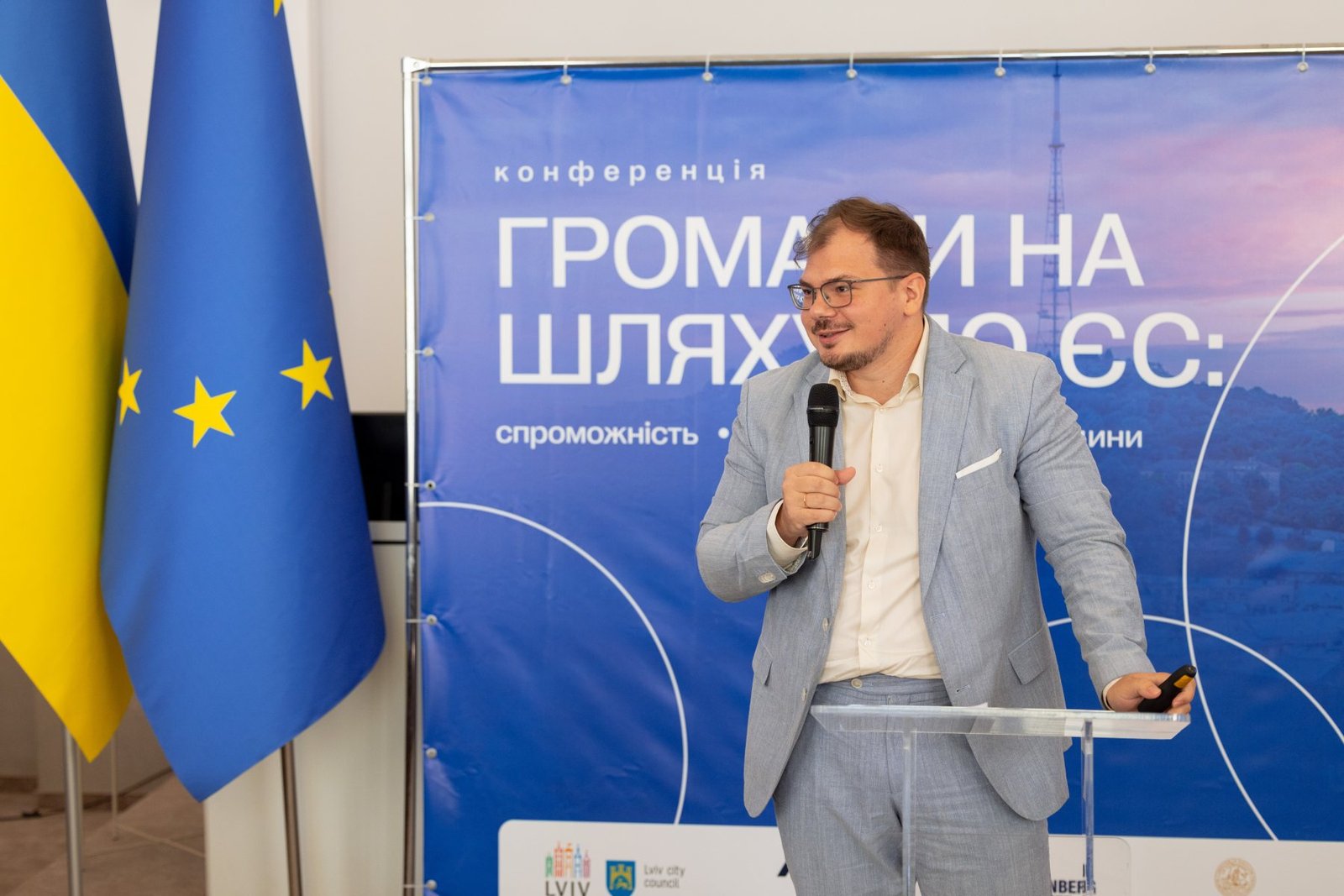
A two-day conference in Lviv on what Ukraine's EU accession requires of communities today: capacity, access to EU resources and human rights. I gave the opening keynote; the conference was opened by Lviv Mayor Andrii Sadovyi, with contributions from Viktoriia Lobun, adviser to the Deputy Prime Minister for European and Euro-Atlantic Integration, Deputy Mayor Andrii Moskalenko and Nataliia Haletska of the Lviv Regional Council.
On 5 October 2026 I gave the opening keynote at the conference "Communities on the Path to the EU: Capacity, Resources and Human Rights" in Lviv. More than 100 representatives of communities, local self-government bodies, state and regional institutions, together with Ukrainian and international experts, met at Lviv City Council to discuss what European integration means for communities today.
What was discussed
The first day opened with the role of the local level in Ukraine's accession to the EU. Participants from the local, regional and national levels looked for answers to practical questions:
- what communities can already do within the European integration process
- which capacities and management systems need strengthening
- how to prepare for implementing European requirements at the local level
- how to use international partnerships and future EU funding opportunities
A separate discussion covered the future Cohesion Policy and EU structural funds: quality projects, strategic planning, institutional capacity and partnerships. The two-day programme also included panels on the rule of law and human rights at the local and regional level, and on inclusion, accessibility and social resilience.
The organisers' conclusion from the first day: preparing for EU accession is not a matter for the future. Communities can act now.
My points
- The main thesis. Ukraine does not need to "go to Europe": it is at its centre, as the stone placed near Rakhiv in 1887 says. What it needs is to build Europe at home, and only communities can do that.
- Where we are. This summer Ukraine opened the first two of six negotiating clusters, "Fundamentals" and "External Relations". The National Programme for the Adoption of the Acquis contains 1,875 tasks, and by the European Committee of the Regions' estimate up to 70% of EU legislation concerns the local level or is implemented by it. An accession planned without communities is one that communities will not be able to deliver.
- Capacity. Poland joined the EU in 2004 at 51% of the EU average GDP per capita and now stands at 80%, because its municipalities learned to prepare projects, run tenders and report before the large funds arrived. Rzeszów and Lublin both opened EU-funded airports in 2012: same money, same rules, different local decisions. The first question for any project is who will pay for it in ten years.
- Resources. The Ukraine Facility regulation requires at least a fifth of the grants under its first component to go to regions and communities. I proposed an "authorised community" status, modelled on the Authorised Economic Operator in EU customs: communities that deliver results without irregularities, time after time, should face less paperwork and get money faster. Resources are also partnerships: about 2,100 with communities and regions in the EU, including more than forty with Sweden.
- Human rights and the rule of law. This is the operating system without which no European programme will work. A policy that lies in a drawer is worse than no policy. Inclusive and social infrastructure for those returning from the war is not charity: it is what a European home looks like.
- Three questions I left with the audience. Who in your community is responsible for Europe tomorrow morning? Do you have a project you will be able to maintain in ten years, when the grant ends? Do you live by the rules you wrote yourselves, and is your community ready to meet those who return from the war?